


Our Vision
- Providing effective services to the public through new modernized administration.
Our Mission
- According to the policy of the state upgrade the development and socio cultural values of the district using the available resources in an effective waythrough integration.
District Map
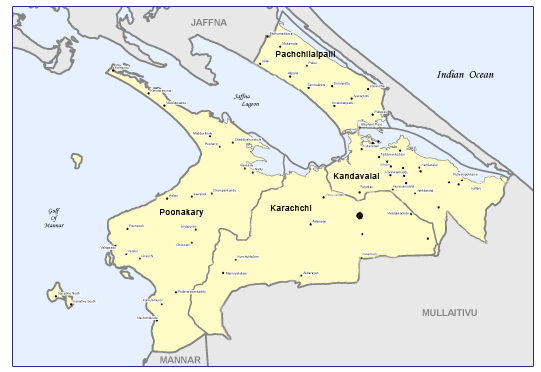
Kilinochchi District was created as the 25th administrative district of the country in 1984 which was earlier came under the purview of the administrative district of Jaffna. This is in the Northern Province of Island, and located in the Northern part of Srilanka.The boundaries of the District are: North –Jaffna District; East and part of SouthMullaitivu District; West and part of South Mannar District.
Soils and Ground Water Potentials
| Red and Yellow latesol | 12.04 % |
| Flat to slightly undulating terrain | 29.99 % |
| SoladizedSolonistz of Solo chck Flat terrain | 27.99 % |
| Alluvial soil of various drainage and texture | 11.99 % |
| Regasoil on recent beach and duore sand flat terrain | 17.99 % |
| Eroded land | 4.06 % |
Land Use Patterns
|
TYPES OF LAND |
CATEGORY |
District |
|
|
Total (in Ace) |
in % |
||
|
Urban Land |
Built-Up Land Associated |
70 |
0.1 |
|
Non-agricultural Land |
580 |
0.5 |
|
|
Agricultural Land |
Homesteads |
13,200 |
10.3 |
|
Tree and other |
3,080 |
2.4 |
|
|
Perennial Crops |
1,460 |
1.1 |
|
|
Crop Land |
27,910 |
21.8 |
|
|
16,300 |
12.7 |
||
|
700 |
0.5 |
||
|
Forest Land |
Natural Forest |
24,850 |
19.4 |
|
10,250 |
8.1 |
||
|
Forest Plantations |
10 |
_ |
|
|
Range Land |
Shrub Land |
10,230 |
8 |
|
Grass Land |
420 |
0.3 |
|
|
Wet Land |
Forested |
610 |
0.5 |
|
Non-Forested |
5,070 |
4 |
|
|
Water Land |
7,390 |
5.8 |
|
|
Barren Land |
5,800 |
4.5 |
|
|
Total |
127,930 |
100 |
|
The entire division is more or less flat and there are 07rivers in the District. There are some drainage channels and there 32118.17 Ha extent ofForest reserveand there are bushes, scrubs and graze lands.3,966.01 Ha extent of state forest in this district.The District covers divisional secretariat Karachchi;Kandawalai; Pachchilaipalli and Poonagariand there are 95 GN divisions in the district.The areas of these Divisional Secretariats are 410.96 Sq.km, 209.70 Sq.km, 167.70 Sq.km, and 448.75 Sq.km respectively.There are three Local Government Administrative Bodies i.e. KarachchiParadeshiya Sabha; PoonagariParadeshiya Sabha and PachchilaipallParadeshiya Sabha
The District falls within Dry Zone eco-climatic division of the island. The average annual rainfall is in the region of 1520.57 m.m. The District receives nearly 75 % of the rainfall during the North-East monsoonal period from September to December. The remaining period of the year is dry with the driest period being June to August. The average monthly temperature ranges from' 25' to 30'c.
During the conflict situation which prolonged nearly thirty decades make the families to displaced from time to time places to places and the Economic sector of the district mainly agriculture sector had been badly affected the traditional agriculture lands turned as scrub lands. Before the conflict period agriculture sector is developing and production level of agriculture sector is increase. Whole of The displaced families started resettling in their places of origin with the certification of “No mine threats” in these Villages. The resettlement is going to be an important occurrence from 2009 May and it continues. The people of Kilinochchi District are40035 families with 129247members as at28.02.2013the main occupation of this District is Agriculture and then comes fishing. As far as agriculture is concerned, there are 08 major irrigation tanks and 394 minor irrigation tanks cater the needs of agriculture. Paddy cultivation is the important activity in the law land and the high land high land crops are the important agriculture activities. Which include coconut cultivation and vegetable and cereals such as green gram, black gram etc. are the main livelihood activities.
Fisheries are the second largest occupation of the people of the District. The District has two coastal belts-one of 28 miles in the East and another of 52 miles in the West. The fishermen are engaged in deep-sea fishing and Karavalai fishing. The District has 30 fishing villages with great potentials for exploitation in the seas. However the prevailing exercise of restriction coupled with the disturbing situation has adversely affected the fishing industry. Fresh-water fishing is resorted to in Iranamadhu Tank, Akkarayan Tank, Vannerikulam Tank, and Kariyalainagapaduvan Tank and Piramanthanaru.
As regard to other industries Paranthan Chemical factory and the Elephant pass stolen were famous industries prior to the conflict situation. The infrastructures of chemical factory and the Elephant pass stolen were completely damaged during the period of turbulence.
Resettlement in the District, major development project in the sectors of Irrigation, Transport, Health, Education, Local Government, Housing and Development of Livelihood were taken up by the Government and other Organizations. As far as Kilinochchi District is concerned 32899 houses have been fully damaged and 8040 houses partly damaged. Out of this, 16078 houses have been newly constructed and 3120 houses have been reconstructed with the assistance of Government and PTF intervention project. Balance of 16821 new houses to be constructed and 4920 houses to be repaired.
Location and Area
Kilinochchi district is situated in the Northern Part of Sri Lanka. Geographically most of the area of the district lies on the main land. The district covers a land area of approximately 1237.11 sq.km and inland water covers an area 0f 444.30 sq.km. The Kilinochchi district has Jaffna district on its Northern border, Mullaitivu in the Eastern and Southern borders and Mannar district on its western and Southern borders.Administratively, the Districtis divided into four divisional Secretariats. They are Karachchi, Kandawalai, Poonagari and Pachchilaipalli.
The land in Kilinochchi District could be characterized as flat with less than 10% slop. There are 4 Major,4 Medium tanks and 457 minor Tanks all over the district connected 7 revers to conserve rain water.The level are Karachchi 4m, Kadawalai 3m, Poonagari 2m and Pachchilaipalli 3m above sea level.
Climate andrainfall
The climatically conditions of this District are dry, humid and tropical. The average annual rainfall in this districtis 1154 mm and 75 % of the rainfall receives during the period from September to December by North-East monsoonperiodical wind. The remain period other than aforesaid of the year is dry and warm. Because, of the warm temperature experiences every year from June to August, this period is considered as dry season.The monthly average temperature range is 25’ to 30'c.
Soil andnaturalresources
The Soil ofthe District is fertile andhavingenough mineralsforthe better growth ofany kindofcrops.
Soil Structure and Types
|
Land and use pattern
Land Use survey of 1985 reveals that 35% of the district land is coming under paddy and seasonal crops. Paddy land accounts for 45% of the agriculture land. Sparsely used cropland and other crops cover 13.2% of the land and perennial crops like coconut, palmyrah, jak,mango,cachew and other frits crops cover 28% of the agriculture land. The natural forest and forest plantation covers 27.5% of the district land area.
Distribution population
The total estimate population accommodated in this district was about 128926in 2012. Karachchi administrative division has the largest population of 69708 and the population density of this division of this division is 170 per sq.km , Kandawalaiadministrative division has the largest population of 24297 and the population density of this division of this division is 116 per sq.km, Poonagari administrative division has the largest population of 23456 and the population density of this division of this division is 52 per sq.km and Pachchilaipalli administrative division has the largest population of 11465 and the population density of this division of this division is 68 per sq.km. The following able indicates the population distribution density in four Divisional Secretariats of the district.
Occupation
Cultivation of paddy is the occupation for more than 70% of the district population. An extent 22,742 hectares was targeted for cultivation during Maha 2012/2013, but actual extent cultivated only 81.5% of the target and the acreage harvested was19,559 hectares. Fishery is the second largest occupation of the people of the district. The district has two coastal belts, one of 28 miles in the east, and another of 52 miles in the west. The fishermen are engaged in deep – sea fishing and coastal fishing.
There are five fisheries division to manage the fisheries resources of the district. They are Nachchikuda, Poonagari, Paranthan, Kandawalai and Pachchilaipalli . There are 28 fishing villages and 39 fishing centers. At about 3432 fishermen are directly involved in marine fisheries, among them 3383 are active fishermen.Four major and four medium tanks are the perennial sources for fresh water fishing. 370 fishermen are engaged in fresh water fishing.
Livestock farming is the third important occupation of the people, largely integrated with crop husbandry. The farmers with the main intention of improving family income are raising livestock; in addition to meet their domestic nutritional requirements of milk, meat and eggs as well as for farm power. Livestock farming in the district forms an integral part of traditional mixed farming system where animal draught power and stock residues are fully utilized for crop production.
Economy
Cultivation of paddy, other food crops and vegetables is the main economic activity in the district. There are eight major / medium tanks in the district. There are four major and 4 medium tanks in the district that provide irrigation facilities for paddy cultivation. The district has about 457minor tanks of which only 374 are in working condition. In addition, nearly 11464 wells are in use. The minor tanks and wells supply water through lift irrigation for subsidiary food crops and vegetable cultivation during the Yala season. During the import controlled, closed economic policy regime period, the district agriculture sector including livestock sector thrived lavishly. Fishing is the second important economic activity of the people. The district has two coastal belts; ne of 28 miles length in the east and another of 52 miles in the west. Fishermen are engaged in deep-sea fishing and coastal fishing. There are 28 fishing villages and 39 fishing centers. Livestock farming is the third main economic activity of the people, largely integrated with crop cultivation. The famers are raising livestock with the main intention of improving family income, in addition to meet their house hold dietary requirement of milk, meat, eggs as well as their farm power.
Employment
Recent data economically active population is not available. However, it is estimated that approximately 70% of the population is involved in agriculture activities, which include marine as well as inland fisheries, livestock faming and forestry. The service sector has not developed fast enough to absorb educated unemployed youths. There is seasonal unemployment and under employment prevail among marginal farming and fishermen communities in the district.
Environment
It has been pointed out that nearly 75% of the land in the district is under forest cover while the marginal lands accounts for 60% of the total area. The protracted conflict for nearly two decades paved the way for destruction of valuable timber in the forest. It has resulted with shrinkage of forest cover. During seventies and early eighties, a large number of tube ells and open dug wells have established. Over extraction of underground water without sufficient recharge would be environment hazard. Rehabilitation and de-silting of minor tanks would facilitate percolation of rainwater into the ground.
Industry
The major industries that existed during the pre – conflict period, Paranthan, Paranthan Chemicals and the saltern have been fully destroyed and abandoned. After the signing of CFA & MOU few services oriented small scale industries are in operation. There are 94 Rice mills functioning in this district. Most of the affected industries are unable to rehabilitate due to lack of capital. Neither compensation nor soft loan facilities are granted so far.
Government Agents/ District Secretaries
| S.No | Name of Government Agents | Service | Period of Service | |
| 01 | Mr.N.Jaganathan Esq. | SLAS | 1984 February | 1986 March |
| 02 | Mr.S.Shanmugarasa Esq. | SLAS | 1986 April | 1986 June |
| 03 | Mr.T.Senthilnathan Esq. | SLAS | 1986 July | 1987 March |
| 04 | Mr.K.Thevasikamani Esq. | SLAS | 1987 April | 1989 November |
| 05 | Mr.S.Anton Alfred Esq. | SLAS | 1989 December | 1990 March |
| 06 | Mr.S.Amirthalingam (Acting) Esq. | SLAS | 1990 January | 1990 February |
| 07 | Mr.K.Manickavasakar Esq. | SLAS | 1990 April | 1991 April |
| 08 | Mr.K.Ponnampalam Esq. | SLAS | 1991 April | 1995 January |
| 09 | Mr.S.Thillainadarasa Esq. | SLAS | 1991 April | 1998 January |
| 10 | Mr.T.Rasanayagam Esq. | SLPS | 1998 January | 1999 August |
| 11 | Mr.E.Iyathurai Esq. | SLAS | 1999 August | 2002 July |
| 12 | Mr.V.Visuvalingam (Acting) Esq. | SLAS | 2002 August | 2002 August |
| 13 | Mr.T.Rasanayagam Esq. | SLPS | 2002 August | 2007 April |
| 14 | Mr.N.Vethanayagan Esq. | SLAS | 2007 May | 2009 August |
| 15 | Mrs.S.Emeldasukumar (Acting) Esq. | SLAS | 2009 August | 2009 November |
| 16 | Mrs.Rubawathy Ketheeswaran Esq. | SLAS | 2009 November | 2015 March |
| 17 | Mr.Suntharam Arumainayaham Esq. | SLAS | 2015 March | 2019 November |
| 18 | Mr.S.Sathiyaseelan (Acting) Esq. | SLAS | 2019 November | 2020 January |
| 19 | Mrs.Rubawathy Ketheeswaran Esq. | SLAS | 2020 January | 2024 February |
| 20 | Mrs.N.Inbaraj(Acting) | SLAS | 2024 February | 2024 March |
| 21 | Mr.S.Muralitharan(Acting) | SLAS | 2024 March | 2025 January |
| 22 | Mr.S.Muralitharan | SLAS | 2025 January | Up to Date |